Puerto Rico Coffee Tours — Questions Answered
Everything travellers ask before booking a coffee farm day in Puerto Rico, answered from the operators' own listings and from what the haciendas publish. If a question here is not covered, send it over.
Booking a tour
Do I need to book Puerto Rico Coffee tours in advance?
Yes for the farm tours, and two to five days is usually enough. The mountain operators run one group at a time and cap it at ten or twelve travellers, so a Saturday in high season goes early. Booking ahead costs the same as booking late and buys you a free-cancellation window to change your mind in.
How far ahead should you make a Puerto Rico Coffee booking?
Two to five days covers most of the year. One operator reports its bookings landing an average of 87 days ahead, which tells you how far in advance its regulars plan. Over Christmas, Semana Santa and the North American spring break, give it a week or more.
Can I make a Puerto Rico Coffee reservation for one person?
Yes, and solo travellers are welcome on every tour here. No tour here sets a minimum party size, so a booking for one confirms the same way a booking for four does. On the smaller farm mornings a single booking often ends up feeling private.
Can I change or cancel after booking?
Yes, up to 24 hours before the start time, on every tour here, for a full refund. Inside that window a change counts as a cancellation, so move it as soon as you know. Weather is the usual reason and the operators are used to it.
What does reserve now, pay later mean?
It holds your place without taking payment, and you pay closer to the date. Several of these tours offer it, and it pairs well with free cancellation while your plans are still moving. The fare is the same either way.
How quickly is a booking confirmed?
Most confirm at the moment you book. You get a mobile ticket rather than anything you need to print, and the meeting-point details come with it. Check the departure time on your confirmation against the time your tour actually leaves, before you travel.
What happens if it rains on the day?
The tours run. These are outdoor farms in a region that takes about 75 inches of rain a year, so rain is normal rather than exceptional and the walks are built for it. If a storm makes it unsafe the operator can call it off, and the free-cancellation window means you can also make that call yourself the day before.
Is it cheaper to turn up at the farm gate?
At one hacienda, yes, and at the rest you cannot. Hacienda Muñoz in San Lorenzo runs its own 75-minute walking tour Friday to Sunday at $21.99 for adults, first come first served. Every other farm here is visited on a booked tour, and there is no gate to turn up at.
Prices and what is included
How much do Puerto Rico Coffee tours cost?
From $36 for an hour and a quarter on a farm above Utuado. A two-hour cacao farm walk in the west is $75 and a three-hour coffee walk through Old San Juan is $88. The full-day mountain tours out of San Juan run $190 and $210.
Why do Puerto Rico Coffee ticket prices vary so much?
Three things move the number: whether transport is inside the fare, how many hours you get, and how far into the mountains you go. A $36 morning is you driving yourself to one farm for 75 minutes. A $210 booking is hotel pickup at seven, eight hours, two mountain stops and lunch.
What does the fare include?
A guide and a tasting, on every tour here. Beyond that it varies sharply: two include hotel pickup or a van, one includes a full lunch, and one includes nothing but the guide and two coffees. Each card states its own list.
Are meals included on a Puerto Rico Coffee tour?
On one tour only. The full-day tour from San Juan includes a criollo lunch at a country restaurant; the six-hour tour leaves breakfast, coffee and lunch as optional extras at roughly $11, $4 and $15 to $25 a head. The shorter farm tours include a snack or a tasting rather than a meal.
Is there an admission fee on top of the tour price?
No. Where a farm charges entry, the booked tours already cover it, and nothing here asks you for money at the gate. The only admission price published anywhere on the island is Hacienda Muñoz's own walk-in fee for people arriving without a tour.
How much is entry to Hacienda Muñoz without a tour?
$21.99 for adults and $11.99 for children aged six to ten and visitors over sixty, plus tax, with under-fives free. That buys the hacienda's own 75-minute guided walk, which runs Friday, Saturday and Sunday only. It is first come, first served, so no reservation is taken.
Do I need to tip?
It is not built into any of these fares. On one tour a gratuity is not expected but is always appreciated, and the rest say nothing either way. Ten to fifteen per cent is the usual gesture on the island if a guide has made the day.
Can I buy coffee at the farm?
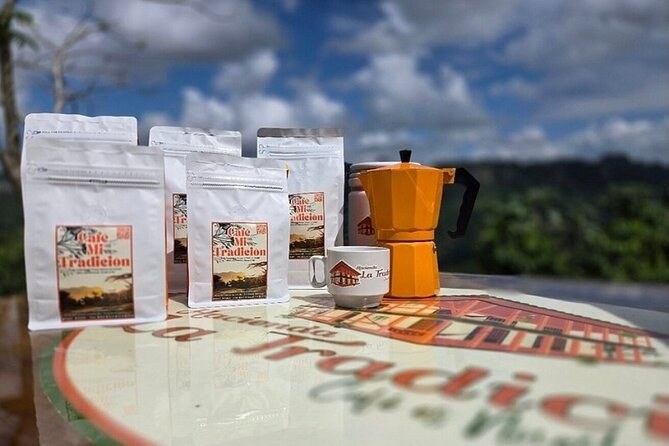
Yes, at every farm here, and it is often the only way to get that particular coffee. About 97 per cent of the island's crop is drunk on the island, so an estate bag bought at the gate rarely turns up anywhere else. Bring cash as well as a card.
On the day
Do I need a car to visit a Puerto Rico coffee farm?
Not for most of them. Two full-day trips collect you in San Juan and one walking tour never leaves the city, so a hire car is only needed for the farm above Utuado. Driving yourself into the mountains is straightforward but slow, and the roads bend constantly.
How long does it take to drive from San Juan?
Allow around ninety minutes to two hours to the central mountains, and about an hour to the eastern hills. Distances on the island are short and the mountain roads are not, so the map time is always optimistic. The booked tours build this into their day, which is most of what the fare buys.
What should I wear?
Closed shoes with grip, and clothes you do not mind getting damp. The ground on a working farm is uneven, often wet, and sometimes steep, and open sandals make the walk harder than it needs to be. A hat and sunscreen matter as much as a rain layer.
How much walking is involved?
Between twenty minutes and an hour and a half, depending on the tour. The cacao farm in the west is a continuous hillside walk on prepared paths; the mountain coffee farms mix short walks with time at the processing yard and the tasting table. Old San Juan is three hours on cobblestones.
Are Puerto Rico coffee tours suitable for children?
Several are, and one is built for it. The cacao farm walk gives children something to hold, taste and watch every few minutes, and reviewers travelling with young children and teenagers both rate it highly. The eight-hour mountain day is a long time in a vehicle for a small child.
Are the farms wheelchair accessible?
No. Every listing here says it is not wheelchair accessible, and two of them add that they are not suitable for travellers with mobility impairments. Farm ground is uneven by nature. Anyone who needs a level surface will get more out of a coffee shop route through Old San Juan than a hillside.
What language are the tours in?
English on every tour here, with Spanish available on several. The Old San Juan walk runs in both, and the mountain tours are led by bilingual guides. If you want the hacienda's own walk-in tour in English, only the ten o'clock departure is English.
Is there a toilet at the farms?
Yes at the farms that take visitors as a business, and the cacao farm lists bathrooms among its facilities. On the full-day tours the stops are spaced so that there is somewhere every couple of hours. Assume the mountain roads themselves have nothing.
The coffee itself
When is the coffee harvest in Puerto Rico?
Hand picking runs from August to January. The same trees are picked three or four times over that stretch, because cherries on one branch ripen at different rates. Outside those months a farm tour shows you the trees, the machinery and the process rather than a harvest in progress.
Is a Puerto Rico Coffee tour worth it out of season?
Yes, and the processing is often easier to follow when the yard is not full. Between February and July you see the flowering, the nursery, the pulper, the drying deck and the roaster without a picking crew moving through them. What you lose is the chance to put a basket on and pick.
Where is coffee grown in Puerto Rico?
Across 22 municipalities in the western and central highlands. Adjuntas, Lares, Maricao, Yauco and Jayuya are the names that come up most, and the farms sit between roughly 760 and 1,200 metres. Nothing much below that altitude produces the arabica these farms sell.
Is there a coffee and chocolate tour in Puerto Rico?
Not as a single booking, and no listing here sells both. The cacao farm above Moca is chocolate from the first minute to the last and grows no coffee; the four coffee tours involve no chocolate. Book the cacao walk and one coffee farm and you have covered both in a day and a half.
What coffee varieties are grown in Puerto Rico?
Caturra, Borbón and Limón, all of them arabica. The trees are grown without irrigation, on rain alone, and first pruned at seven or eight years old. That is the same set of varieties the haciendas were replanted with after 2017.
Why is Puerto Rican coffee so hard to find abroad?
Because the island drinks almost all of it. About 97 per cent of the crop is consumed locally and under three per cent is exported, on a harvest that runs well below what the island itself gets through. Buying at the farm is the reliable way to take some home.
Was Puerto Rican coffee really served to the Pope?
Yes. Through the 1950s and 1960s the Vatican bought about 15,000 quintals a year — a quintal is a hundred pounds — and Yauco's growers had been supplying Europe since the 1800s. It is where the old line about the coffee of popes and kings comes from.
What happened to the coffee farms in Hurricane María?
September 2017 destroyed roughly 80 per cent of the island's coffee trees and cost growers about $85 million. A coffee tree takes years to come back into full production, so the farms you visit today are working through a replanting that began with hundreds of thousands of seedlings. Several of the tours here exist because of that recovery.
Still deciding? Compare every Puerto Rico Coffee tour side by side, read how a farm day works, or start with Puerto Rico Coffee Tours.