Puerto Rico Coffee Country Weather
Puerto Rico's coffee grows where the rain falls, so weather is not a comfort question here — it is the reason the farms are up there at all. What follows is the mountain interior, month by month, and what each month does to a day on a farm.
What the weather does to a coffee-farm visit here
Three things. First, the tours run in rain, because a farm that stopped for rain would stop for half the year. Second, the ground gets slick, which is why every listing here asks for closed shoes and why none of them is wheelchair accessible. Third, the wettest months are also the picking months, so the best time to watch a harvest is not the driest time to walk one.
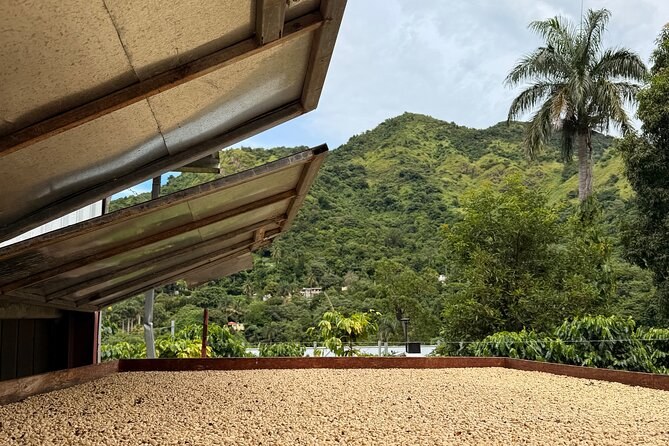
The number that matters: the coffee region averages about 75 inches of rain a year, and the crop is grown on that alone with no irrigation. A coffee farm tours in Puerto Rico in October is a wet day with a full drying deck. The same tour in March is a dry day with an empty one.
Puerto Rico's coffee country month by month
Figures below are for Adjuntas, in the middle of the coffee belt at about 550 metres, and they run wetter and cooler than San Juan on the coast.
January
79°F by day, 55°F at night, and 2.36 inches of rain across the month — one of the two driest. Picking finishes on the highest ground, so this is the last month you can catch a harvest without the wet. Roads are at their best. Book any time of day.
February
80°F and 54°F, the coolest nights of the year, with 2.72 inches of rain. The picking is over and the yard is quiet, which makes the machinery easier to follow. Yauco and Maricao both hold their coffee festivals this month. Take a layer for the evening if you are staying up there.
March
80°F by day and 3.82 inches of rain, still comfortably in the dry half of the year. Flowering starts on the lower farms and the hillsides go white for a day or two. Nothing is being picked. Good driving, good visibility, no crowds.
April
81°F and 6.06 inches — the month the rain steps up. Showers are short and usually afternoon, so a morning tour still runs dry. The trees are setting green fruit. Bring a light shell rather than an umbrella.
May
83°F and 8.23 inches, the first genuinely wet month. Afternoons close in and the mountain roads run with water. Book the earliest departure you can get. There is no harvest to see and the farms know it, so the tours lean on the processing.
June
84°F, nights at 62°F, and 4.84 inches — a lull between two wetter stretches. Hurricane season opens on the 1st, which matters for planning rather than for any given day. Green fruit is filling out on the trees.
July
85°F and 6.22 inches, the hottest month by a degree. Shade is scarce on a drying deck, so a hat does more than sunglasses. Still no picking. The last comfortable month before the wettest stretch of the year.
August
85°F and 8.19 inches. Picking starts on the lower farms, which makes this the first month you can watch a harvest — and the month the Atlantic season starts producing storms. Free cancellation is the reason to book anyway.
September
84°F and 12.13 inches, the wettest month of the year by a clear margin, and the statistical peak of hurricane season. The picking is under way and the drying decks are covered for a reason. Keep the day flexible and watch the forecast.
October
84°F and 10.87 inches. Wet, and the middle of the harvest: pulper running, decks full, crews in the rows. If you are coming for the coffee and can handle rain, this is the month with the most to see.
November
82°F, 60°F at night, and 5.51 inches as the rain eases. Hurricane season closes on the 30th and the harvest is in full flow. Jayuya's indigenous festival falls this month. This is the best all-round month of the twelve.
December
80°F and 2.72 inches — dry again, with picking still going on the higher farms. Cool nights in the mountains and clear days. Book early: it is the busiest travel month on the island.
The seasons, and which one you want
| Season | Months | What you get | What you give up |
|---|---|---|---|
| Dry and cool | December – March | Best roads, clearest days, festivals in February | Only January still has picking |
| Building rain | April – July | Flowering, green fruit, quiet farms, easy listening | No harvest at all |
| Wet harvest | August – November | The full working farm: picking, pulping, drying | The wettest weeks of the year, inside hurricane season |
Hurricane season, and how to book inside it
The Atlantic season runs from 1 June to 30 November, and September is its peak. That overlaps the first four months of the coffee harvest, which is awkward and unavoidable. Book the date you want and rely on the 24-hour free-cancellation window every tour here carries. A named storm is forecast days out, not hours, so you will have time.
The island knows how to do this. María, in September 2017, took about 80 per cent of the island's coffee trees, and the farms you visit are the ones that replanted.
Best time of day
Morning, in every month. Cloud builds over the Cordillera Central through the afternoon and the heaviest rain tends to arrive after two o'clock. The early departures also catch the farms while the day's work is being done rather than after it. If you are driving yourself, being off the mountain roads before dusk is worth planning for.
What to wear when it is wet
- Closed shoes with grip. The one non-negotiable. Wet farm ground on a slope is no place for sandals.
- A light shell, not an umbrella. You need both hands on a hillside path, and the rain is warm.
- A hat. The drying decks are open to the sky by design and shade is patchy.
- A dry layer in the bag. Nights in the coffee towns drop to the mid-fifties in February.
Frequently asked questions
What is the best month for a Puerto Rico coffee tour?
November. The harvest is in full flow, the rain has dropped to about five and a half inches for the month, and hurricane season closes on the 30th. December and January are drier still but the picking is winding down.
Do coffee tours run in the rain?
Yes, and they run in it often. The coffee region takes around 75 inches a year and none of the crop is irrigated, so rain is the normal condition rather than the exception. Lightning is what stops a tour, and at that point the operator refunds or moves it.
Should I avoid hurricane season?
Not necessarily, but book with the free-cancellation window in mind. The season runs 1 June to 30 November and September is its statistical peak. Most days in those months are simply wet rather than dangerous, and the picking season sits inside them.
How much colder is it in the mountains?
Enough to want a layer after dark. Nights in the coffee towns drop to the mid-fifties in February and stay in the low sixties in summer, while the coast rarely goes below seventy. Days are only a few degrees cooler than San Juan.
Once you have a month, the picking calendar says what will be happening on the farm, and the practical page has the fares and the drive times. Every tour on Puerto Rico Coffee Tours refunds in full up to 24 hours before it starts.
Tours that run whatever the sky is doing