The Best Time for a Puerto Rico Coffee Tour
Short answer. November, if you can choose freely. The harvest is in full flow, the rain has eased to about five and a half inches for the month, and hurricane season closes on the 30th. December and January are drier and still have picking. February to July gives you a quiet farm and a green hillside.
Three calendars overlap on this island and they do not agree with each other: the picking season, the rain, and the Atlantic hurricane season. Getting the month right is worth more to a coffee day than getting the tour right, so here is how the three fit together.
When is the coffee harvest in Puerto Rico?
August to January, picked by hand, in three or four partial passes over the same trees. Cherries on one branch ripen at different rates, which is why the season runs six months rather than six weeks, and why a farm can be picking in August and picking again in December.
Lower farms come in first and the highest ground in the Cordillera Central is still going in January. If watching a crew work the rows is the point of your trip, October to December is the middle of it.
When does it rain, and how much?
Constantly, and more than the coast. The coffee region averages about 75 inches a year, and nothing here is irrigated — the crop lives on that rainfall alone. In the middle of the coffee belt the wettest month is September at about 12 inches and the driest are January and December at around 2.4 and 2.7.
What that means in practice is that a farm day in September is a wet day and a farm day in February is not, and both run. Tours here do not stop for rain.
Does hurricane season rule anything out?
Not on its own. The Atlantic season runs 1 June to 30 November with a statistical peak in September, and it overlaps the first four months of the harvest. Most days inside it are simply wet. A named storm is forecast days ahead rather than hours, so you will have time to move a booking.
The mechanism that makes this workable is the 24-hour free-cancellation window every tour here carries. Book the date you want and keep the option.
September is the wettest month and the peak of the season. About 12 inches of rain in the coffee belt, and the middle of the hurricane peak. It is also full harvest. If you book it, keep the plan flexible and watch the forecast — the month-by-month figures are here.
Month by month, in one table
Rainfall figures for Adjuntas, in the middle of the coffee belt.
| Month | Rain, coffee belt | On the farm | Verdict |
|---|---|---|---|
| January | 2.4 in | Picking finishes on the highest ground | Excellent |
| February | 2.7 in | Quiet yard, coffee festivals in the west | Very good |
| March | 3.8 in | Flowering starts | Very good |
| April | 6.1 in | Green fruit setting | Good |
| May | 8.2 in | Wet, no harvest | Fair |
| June | 4.8 in | A lull; hurricane season opens | Good |
| July | 6.2 in | Hottest month, no harvest | Fair |
| August | 8.2 in | Picking starts on the lower farms | Good |
| September | 12.1 in | Full harvest, wettest month | Fair |
| October | 10.9 in | Full harvest, decks full | Good |
| November | 5.5 in | Full harvest, season closes on the 30th | Best |
| December | 2.7 in | Picking on the higher farms | Excellent |
What is the best month overall?
November. It is the only month that has the harvest at full tilt and the rain already easing, and hurricane season ends inside it. Jayuya's indigenous festival falls in November too, which puts something else in the interior worth the drive.
December and January are the fallback and they are very good: drier still, cool nights in the mountains, and picking continuing on the higher ground. What they lose is the intensity of a farm in October.
When should you come if you want a quiet farm?
February to April. No picking crew, a yard with room to stand in, and a guide who has time for the awkward questions. The flowering in March turns hillsides white for a couple of days and smells like jasmine, which is its own reason to be there.
This is also festival season in the west: Yauco runs the national coffee festival in February and Maricao holds its harvest festival in the same month. Dates move and organisers publish them a few months ahead.
Does the season change what you pay?
No. None of the fares here moves with the calendar, which is unusual and worth knowing: you are not paying a premium to come in harvest. What changes is availability, because the mountain operators cap their groups at ten and twelve travellers and December is the island's busiest travel month.
Book earlier for December and for the spring break than you would for May. The price guide has the bands.
Is the cacao farm different?
Completely, and it is the useful exception. Cacao pods ripen through the year, so the farm at Moca gives you the same visit in April as in November: a harvest demonstration, raw fruit, chocolate at two strengths and husk tea. If your trip falls in the off-season for coffee, that is the booking that does not care.
What does the farm look like in each season?
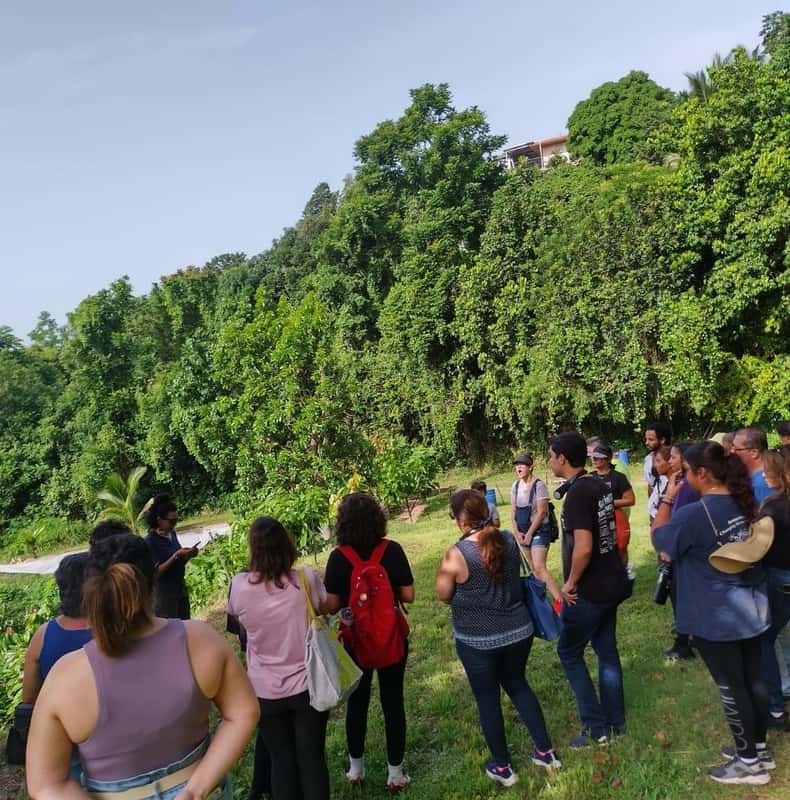
In the harvest, a working yard: pickers moving through the rows with baskets, the pulper running in the afternoon, and the drying deck covered in parchment being raked every few hours. It is noisy, busy and slightly in your way, which is exactly what makes it worth seeing.
Out of season it is a teaching farm. The same machinery, demonstrated rather than in use, and time to look at the trees properly. Spring adds the flowering; late summer adds green fruit swelling on the branch. Neither is a lesser visit, and out of season the guide is measurably less busy.
How far ahead should you book, by month?
Mountain groups cap at ten and twelve travellers, which is what makes a weekend slot go early.
| Month | Book | Why |
|---|---|---|
| December | A week or more | The island's busiest travel month |
| March – April | A week | Spring break, and the mountain caps are small |
| June – September | Two to five days | Quietest visitor months |
| October – November | Five days | Harvest season and good weather together |
| January – February | Five days | Dry, cool and popular with repeat visitors |
What does the season do to the roads?
Rain, mostly, rather than closure. The mountain routes are surfaced and stay open, but in the wettest months they run with water, visibility drops in cloud and the late afternoon is worse than the morning. Landslips happen after sustained rain and are cleared quickly.
The practical rule does not change with the season: take the morning departure and be off the mountain roads before dusk. What the drive is like.
What about the time of day?
Morning, in every month. Cloud builds over the mountains through the afternoon and the heaviest rain tends to arrive after two o'clock. The early departures also catch a farm while the day's work is being done rather than after it, which is most of what you came to see.
Does altitude change the calendar?
Yes, and it is the reason the harvest runs six months. Lower farms ripen first and come in from August; the highest ground in the Cordillera Central is still being worked in January. The farms these tours visit sit between roughly 760 and 1,200 metres, which puts them across most of that range rather than at one end of it.
Practically, that means a December booking is not a late booking. On the higher farms it is the middle of the season, and the weather in December is far better than the weather in September.
What should you pack for the month you have chosen?
- December to March. A light layer for mountain evenings, which drop into the mid-fifties, and normal daytime clothes.
- April to July. A rain shell for afternoon showers, and more sun protection than you think, because July is the hottest month.
- August to November. Proper waterproofs, a dry bag for a phone, and a change of socks. September averages about 12 inches of rain in the coffee belt.
- Any month. Closed shoes with grip. Farm ground does not care what the forecast said.
The seasonal verdict
- Coming for the harvest? October to December, and November first.
- Coming for the weather? January to March.
- Travelling in the off-season? Book the cacao farm, which has no closed season.
- Stuck with September? Book anyway, keep it flexible, and take a rain layer.
Whatever the month, the picking calendar says what will be happening in the yard and the weather page has the numbers. Every departure on guided coffee tours in Puerto Rico refunds in full up to 24 hours before it starts, and Puerto Rico Coffee Tours lists them all.
Frequently asked questions
What is the best month for a Puerto Rico coffee tour?
November. The harvest is at full tilt, rainfall in the coffee belt has dropped to about five and a half inches for the month, and hurricane season closes on the 30th. December and January are drier with picking still going on the higher farms.
When can I see coffee being picked?
August to January. The same trees get three or four partial passes across those months, so any date in that window can put you next to a picking crew. October to December is the busiest stretch.
Is it worth going outside the harvest?
Yes. Between February and July the yard is quiet, the machinery gets demonstrated properly and the guide has time. March brings the flowering, which is worth seeing in its own right.
Should I avoid hurricane season?
Not automatically. It runs 1 June to 30 November and September is its peak, but most days inside it are simply wet and the tours run. Book with the 24-hour free-cancellation window in mind.
Do prices change by season?
No. None of the fares here moves with the calendar. What changes is availability, because the mountain groups cap at ten and twelve travellers and December is the island's busiest month for visitors.
When are the coffee festivals?
February, mostly. Yauco runs the national coffee festival and Maricao holds its harvest festival in the same month; Jayuya's indigenous festival is in November. Dates move year to year, so check with the organiser before booking flights.
What if my trip falls in the off-season?
Book the cacao farm at Moca. Cacao ripens through the year, so it gives you the same visit in May as in November. What that two hours contains.
Tours that suit the month you are travelling